For a men's fragrance line there are two workable routes: hand the whole project to one manufacturer, or split development and filling between two specialists. The one-roof route usually wins on coordination and paperwork, because it removes the handover risk between suppliers; the split route wins when the formula itself is the brand's crown jewel and is developed outside. The decision should be made on where the handover risk sits, not on the price per bottle, and this article compares the two routes side by side.
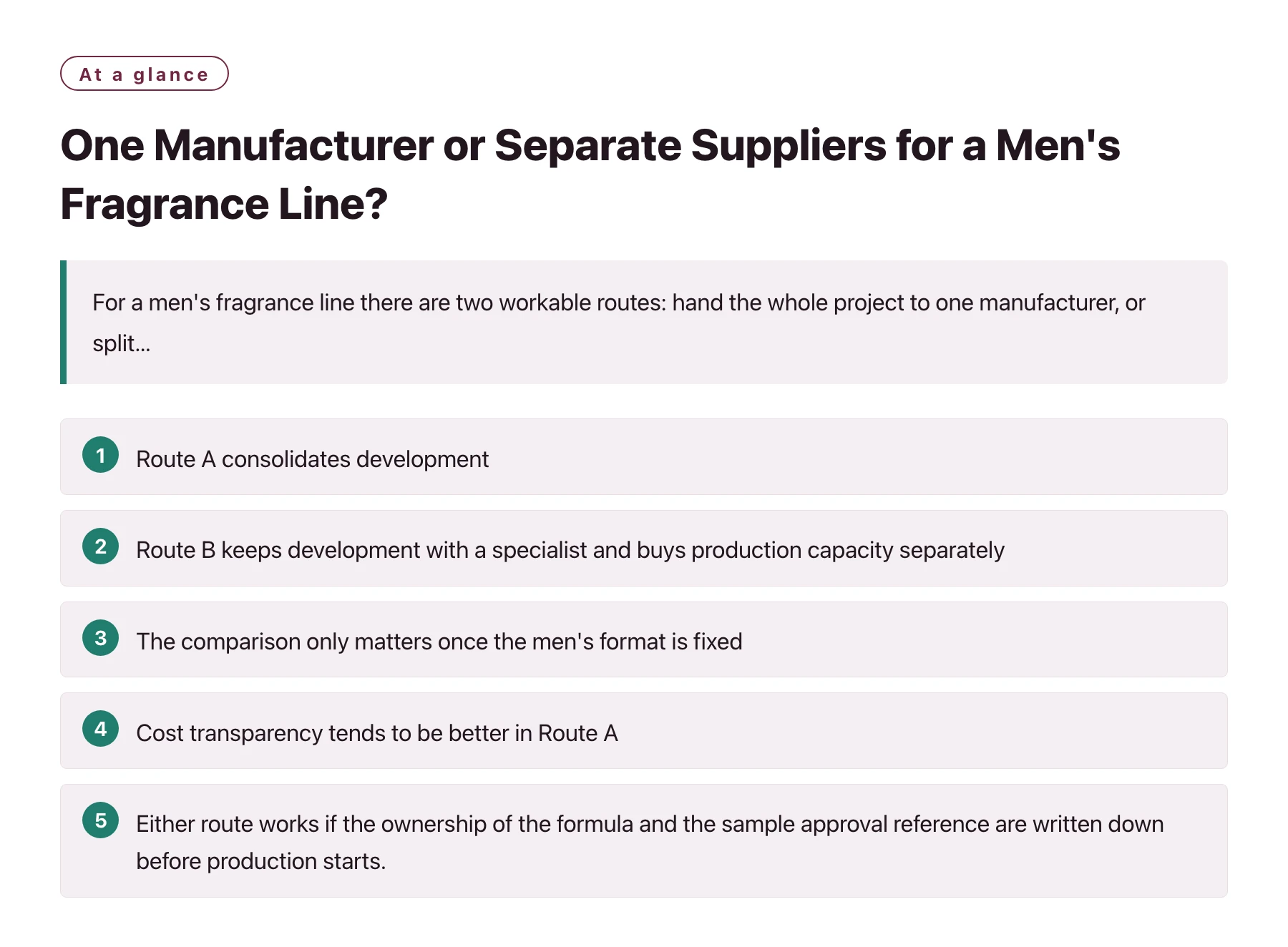
Key takeawaysRoute A consolidates development, production and documentation under one contract, which removes the handover risk between suppliers but concentrates dependency on one partner. · Route B keeps development with a specialist and buys production capacity separately, which protects formula secrecy but makes the brand the integrator. · The comparison only matters once the men's format is fixed, because an EDP, an after-shave and a grooming-adjacent product behave differently in production and carry different category restrictions. · Cost transparency tends to be better in Route A; flexibility in volumes and formulas tends to be better in Route B. · Either route works if the ownership of the formula and the sample approval reference are written down before production starts.
Two founders brief the same men's fragrance. One sends the concept to a single factory and waits for a sample; the other commissions a perfumer for the scent and separately lines up a filling partner. Both can end up with a credible product on the shelf — the difference is what each founder is managing every week in between.
This is the fork that matters most at the start of a men's line, because men's fragrance sits between two markets: it is sold as fine fragrance, yet it is frequently planned alongside grooming products, and the two behave differently in production. The routes below are the two shapes the project can take, with the questions that separate them.
The two routes, defined
Route A is the one-stop model: one manufacturer takes the brief, develops or sources the scent, produces the concentrate, fills, decorates and documents the whole range under one contract and one roof. This is the scope a contract manufacturer describes when it offers perfume OEM manufacturer in China services or equivalent single-supplier arrangements with OEM and ODM options.
Route B splits the chain: an independent perfumer or development house builds the formula, and a separate factory handles compounding, filling, packaging and testing. The brand owns the interfaces — it is the party that makes sure the formula, the packaging and the filling line are compatible, and the party that answers when the bulk does not match the sample.
What Route A assumes about you
Route A assumes the brand can evaluate a single supplier's whole capability honestly. The reward is one voice in the conversation, one quote, one contract and one set of batch records, which is a real simplification for a first launch. The cost is that if the partner is weak in one discipline — say, decoration — there is no second supplier to catch it.
What Route B assumes about you
Route B assumes the brand can act as an integrator: someone has to own the approval at each handover, coordinate the timing of the formula and the packaging, and arbitrate when the filler says the concentrate behaves differently at scale. That is a job, and it is usually the founder's job in a small company.
Route A against Route B
| Question | One manufacturer (Route A) | Separate suppliers (Route B) |
|---|---|---|
| Number of contracts | One, for the whole scope | Two or more, with interfaces between them |
| Who integrates the project | The manufacturer | The brand |
| Formula development | In house or from a library, under the same contract | Independent perfumer, outside the factory contract |
| Quality ownership | One party answers end to end | Split; the brand answers for the interface |
| Formula secrecy | Negotiated via ownership and exclusivity clauses | Easier to protect at the development stage |
| Volume flexibility | Tied to one partner's scheduling | Can shop the filling leg independently |
| Best fit | First launch, defined line, limited team | Established brand protecting a signature scent |
Read the quality-ownership row first. If you cannot say who answers when the bulk does not match the approved sample, the argument for the other route is stronger than any price difference.
What makes the men's category specific
A men's line is usually planned as more than one product: an eau de parfum for the flagship, an after-shave or splash for daily use, sometimes a deodorant or body product. Those formats pull in different directions. The category-based use limits that apply to individual fragrance materials are set per product type in the IFRA standards [1], so a formula built for an alcohol-based EDP is not automatically compliant in a product that stays longer on the skin. Whether the route is A or B, the format list has to be fixed before the development brief — otherwise the formula is developed against the wrong target.
Men's grooming research is its own category
The men's grooming market is tracked as a separate category by consumer research houses, which publish regular reports on how male consumers buy fragrance and grooming products [2]. The practical point for a founder is not the numbers but the structure: the buyer of a men's line is often the same person across fragrance and grooming, so the range is usually judged as a set, and that favours a production route that keeps the set consistent — which is one of Route A's quiet advantages.
The perfume industry's own research flows the same way
Ingredient and creation houses publish their own market studies and regional scent forecasts, and they are freely readable [3]. They are useful background for positioning a men's launch, but they are opinions about tastes, not production facts — treat them as input to the brief, not as evidence about a factory's capability.
Stability and the batch question
Either route must answer the batch question: can the formula be repeated at volume with the same appearance, scent and safety profile? In Route A that answer is one phone call away. In Route B the brand has to assemble the answer from two parties' records, and it should rehearse that assembly once with a pilot run before the real launch — a pilot at the filler, using the real concentrate, is the only test that predicts the bulk. If the formula is already proven, the manufacturing leg can be handled by an OEM partner for perfume brands while the development stays independent, which is a common structure for established men's lines.
If you cannot decide between the routes, run the decision test: name the one manufacturer — or the two suppliers — and then answer the question, who signs the approval when the bulk does not match the sample? If the answer is ambiguous, the route is wrong for you, whatever the quoted price per bottle.
Choosing, and checking the choice
The consistent pattern in the men's category is that first launches do better with Route A: the team is small, the range benefits from consistency, and one contract removes most of the places where a schedule can quietly slip. Brands that already own a signature scent, or that plan a grooming extension later, often migrate toward Route B once the formula is proven, keeping the development independent while the production leg is separately contracted.
Whatever you choose, the checklist is the same. Written scope of what happens in house. Ownership of the formula and the mould settled in the same conversation as the price. A retained physical reference for sample approval. A document pack that matches the destination markets. And a pilot run before the first bulk order.
One way to shorten the check is to start with a partner whose scope and certification list are public, because the checklist then has something concrete to test against. A manufacturer such as Xuelei Fragrance that publishes its service scope and its ISO 22716 and related certifications makes the first pass fast, and the remaining questions are about your product rather than about whether the company exists.
Sources
- IFRA Standards Library (International Fragrance Association) —— The IFRA Standards Library lists the restrictions the fragrance industry applies to individual fragrance ingredients, based on safety assessments; it is the reference point for compliant fragrance formulation.
- Mintel Press Centre —— Mintel's press releases on consumer and beauty market research, including fragrance and personal care trend reporting.
- Givaudan —— One of the largest fragrance and flavour houses; public material on fragrance creation, ingredient portfolio and market segments.
Frequently asked questions
Is one-stop manufacturing more expensive per bottle?
Usually comparable at moderate volumes. The differences show up in coordination time and in the number of places that can slip, not in the unit price. A split route can look cheaper on paper while carrying integration costs that never appear on a quote.
Can I start with one manufacturer and split later?
Yes, and it is a common path for men's grooming lines. The condition is that the formula is transferable: the brand must hold the formula, the mould and the design files, or the move later means rebuilding the product rather than moving it.
Which route suits a small first production run?
Route A, in most cases. One contract reduces the minimum commitments and the number of parties that have to agree before a small order can move. Route B's flexibility only starts paying when volumes and formulas are changing often.
Do I lose control of my formula with one manufacturer?
Only if the contract says so. Ownership of the formula, exclusivity of any new development and the handling of the mould are commercial terms; negotiate them in the same conversation as the price, and get the answer in writing.
How do I check the filler's quality in a split route?
Ask for an audit of its batch records, run a pilot with your real concentrate, and confirm that the filler holds the same sanitary and quality standards your development partner works to. The certificate list is the start of the conversation, not the evidence.